
Argentina vs. Nigeria has produced tight, tactical battles — from Maradona’s 1994 swan song to Rojo’
Argentina and Nigeria have met only a handful of times at senior level。but the fixture carries a peculiar gravity. The most vivid encounter remains the 1994 World Cup in Boston, where Diego Maradona’s last international appearance ended in a chaotic 2-1 win for Argentina — a match overshadowed by Maradona’s failed doping test hours later. That day, Nigeria’s Super Eagles, then African champions, matched Argentina physically but were undone by two moments of Claudio Caniggia’s pace. Since then, every Argentina vs. Nigeria meeting has felt like a test of contrasting football cultures: South American improvisation against West African athleticism. The 2018 World Cup group stage in Saint Petersburg delivered another twist — a tense 2-1 Argentina win that saw Marcos Rojo volley a late winner, while Nigeria’s counterattacks repeatedly exposed a creaking Argentine back line. That pattern — Argentina’s reliance on individual brilliance, Nigeria’s reliance on collective speed — has defined the rivalry more than any scoreline.
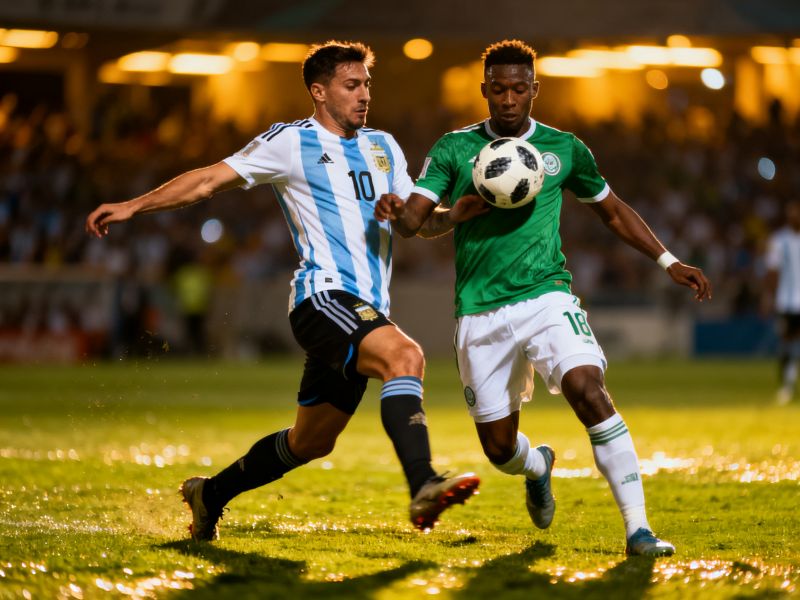
Tactically, Argentina vs. Nigeria often becomes a study in midfield pressing. Nigeria’s 4-2-3-1 under Gernot Rohr in 2018 pressed high and forced Argentina into long balls toward Lionel Messi, who drifted left to escape Wilfred Ndidi’s shadow. Argentina, under Jorge Sampaoli, looked disorganized — players arguing on the bench, the back four unsure whether to hold or step. The 2014 friendly in Abuja offered a different picture: Nigeria’s home crowd and humid conditions slowed Argentina’s passing, and the game ended 1-0 to the visitors thanks to a scrappy goal from Gonzalo Higuaín. My observation from watching those matches: Nigeria’s best spells come when they press in short bursts, not sustained high blocks. Argentina’s weakness — a slow, aging defense — is exactly what Nigeria’s wide forwards。like Moses Simon or Samuel Chukwueze, can exploit. But Argentina’s response is usually pragmatic: slow the tempo, draw fouls, let Messi or Ángel Di María decide the rhythm. That clash of styles makes Argentina vs. Nigeria less about formations and more about who controls the game’s temperature.Player-level matchups add another layer. Messi has scored three goals in four appearances against Nigeria, but his influence often wanes when Nigeria’s midfield, anchored by Ndidi and Alex Iwobi, closes central lanes. In the 2018 game, Messi’s first-half goal came from a rare moment of space — a chest control and left-foot finish that felt almost too easy. Nigeria’s equalizer, a Victor Moses penalty after a Javier Mascherano foul。showed their resilience. I still remember the Nigerian fans in the stadium that night in Saint Petersburg — louder than the Argentine contingent for long stretches, drumming and singing through the second half. That atmosphere matters. Argentina vs. Nigeria is one of those fixtures where crowd energy can tilt a tight game. Nigeria’s 4-0 friendly win in 2011 in Abuja, though a low-stakes match, proved that when Argentina’s stars are half-committed, Nigeria’s pace turns the game into a track meet.What does the future hold?Argentina’s post-Messi transition — already visible in 2023–24 — changes the dynamic. Nigeria, with Victor Osimhen and Ademola Lookman, now has a more direct, vertical threat than the 2018 side. If they meet in a competitive tournament again, expect Argentina to try to compress space between the lines and force Nigeria wide. Nigeria’s best chance is to attack early, before Argentina’s midfield settles. The historical record favors Argentina — four wins in five meetings — but the margins are razor-thin. Three of those five games were decided by a single goal. Argentina vs. Nigeria rarely produces a blowout;
it produces grind。tactical fouls, and moments of individual magic. That’s why neutral fans should want this fixture more often. It’s a genuine stylistic collision, not a friendly exhibition.